Since biblical times and as recorded in the Torah, the Land of Israel was promised to the Jewish people by God and has been sacred to them ever since. After the establishment of the First Kingdom of Israel in about the 11th century BCE the area was ruled by the Israelites sporadically for the next 1000 years.
Over centuries the Jewish presence dwindled due to persecution and massacres at the hands of invaders, the scattering of the Jews throughout the world began. However a Jewish presence constantly remained, particularly in the Galilee which became the religious centre. Eventually after the land had been conquered and ruled over by most of the major civilizations that had power at various times, The Land of Israel was captured in 1516 by the Ottoman Empire who ruled the area up until the 20th century.
Throughout the centuries the Jews who had been dispersed around the world had always had a yearning to return to their land and in 1492 many Jews, on being expelled from Spain, returned to their land and communities began to grow in the four Holy Cities of Judaism : Jerusalem, Tiberias, Hebron and Safed.
Pogroms in Eastern Europe started the first Aliyah in 1881 which was the beginning of what is known as modern immigration. At around that time the Zionist movement founded by Theodor Herzl started to take root. This movement had as its basis the wish to establish a Jewish State in the Land of Israel.
The second Aliyah began in 1904 and those who came were mainly orthodox Jews but amongst them were socialists who began to establish the kibbutz movement. This Aliyah lasted until 1914 and the outbreak of World War I. During the war Arthur Balfour, who was the British Foreign Secretary, issued The Balfour Declaration which favored the establishment of a National Home for the Jewish People in Palestine.
The Jewish Legion, composed mainly of Zionist Volunteers, assisted the British in their conquest of the Ottoman Empire in Palestine. In 1920, rioting Arabs vehemently opposed the Balfour plan and this led to the forming of the Haganah (Hebrew word for Defense).
The years between 1919 and 1929 brought 100,000 Jews returning to their land during the third and fourth Aliyah and after the rise of Nazism the 5th Aliyah began with the arrival of about a quarter of a million Jews fleeing the situation in Europe. This influx caused Arab Riots and resulted in the notorious British White Paper that stopped the arrival of Jews to Palestine. All those Jewish refugees trying to flee the Holocaust were being turned away by countries around the world. This led to the formation of the underground Aliyah Bet organization who sought to bring these Jews to Palestine.
A furious conflict between the Jewish Community and Britain began after 1945 when the Haganah joined the underground movements Irgun and Lehi in armed resistance as thousands of Jewish Refugees and survivors of the Holocaust who were seeking refuge in Palestine were being turned away by the British or placed in Detention Camps.
In 1947 Britain found themselves unable to reach any acceptable solution to the situation and decided to withdraw from the Mandate of Palestine and in November of that year the Partition Plan for Palestine was approved by the United Nations with two states, Arab and Jewish with Jerusalem an International City under U.N. rule. This was accepted by the Jewish leadership but immediately rejected by the Arabs who began a series of attacks against Jewish communities.
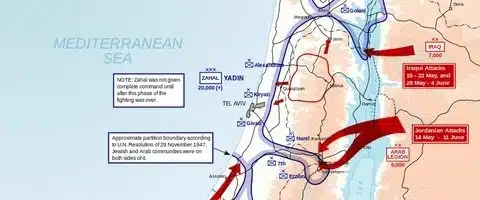
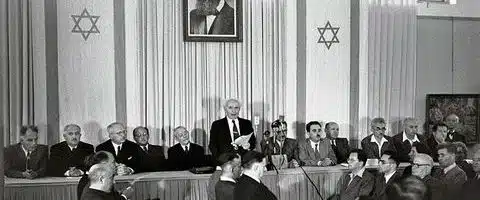
On the 14th May 1948 Independence of the new State of Israel was declared and the next day the armies of 5 Arab States: Lebanon, Syria, Jordan, Iraq and Egypt with contingents from the Sudan, crossed their borders, in an attempt to overthrow the new state and so began Israel’s 1948 War of Independence.


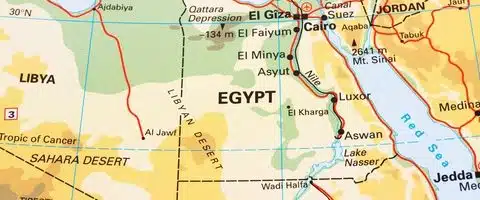
Problems began in July 1956 when British and French interests were threatened by the nationalization of the Suez Canal by
On the 29th October 1956 under the leadership of the Chief of Staff Moshe Dayan, a military operation was launched against Egypt. In the short time of 100 hours the whole of the
From the beginning of the establishment of the State, Israel’s leaders had been expressing a desire for peace negotiations to begin with all its neighbors, however the surrounding Arab States were at no stage ready to reach any sort of peace agreement and in fact all overtures were met with rhetoric that made it clear that their stated goals were to eradicate the Zionist State. During the early part of the 60’s Israel faced constant border attacks especially from Jordan and Lebanon, and shelling of Israeli Kibbutzim and Moshavim in the Galilee from Syrian positions on the Golan Heights.

As the scale of the Israeli victory became apparent, the residents of the Hula Valley as well as those of the Jordan Valley began to lobby the Prime Minister to finally rid their lives of the constant shelling by Syria, by taking control of the 

The result of these actions were that the inhabitants of the cities Suez, Ismailia and Kantara left their homes and the cities became ghost towns. Thus the War of Attrition began.
After the Six Day War the surrounding Arab States, realizing that they had not achieved their objectives in a full scale war, began a strategy of sporadic isolated attacks against Israel – mainly along the Suez Canal and in the Jordan Valley and on a smaller scale on the Golan heights, the Lebanese border and Judea and Samaria, all fighting a terrorist war against Israel and Israeli overseas targets.
As a result the Egyptians pressed hard for even more Russian aid which they received, including Russian pilots who were flying the Russian fighter jets that were supplied to Egypt. An incident took place when a dog fight ensued over the Suez Canal with The Russians engaging with Israeli fighter jets and ended with 5 Russian jets being downed