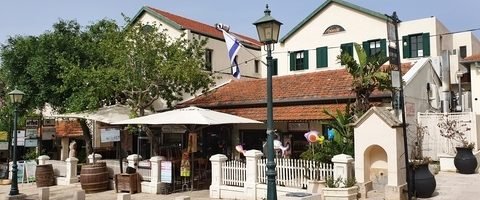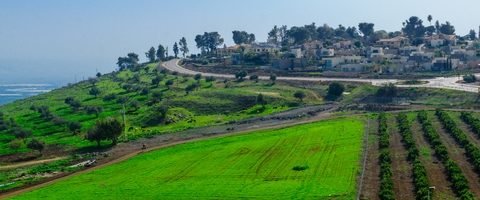
The Town of Atlit in Northern Israel is situated on the Mediterranean coast South of Haifa. It was originally a Crusader outpost. In 1903 the new village was founded with the help of Baron Edmond de Rothschild.
Atlit is best known for the place where the British built a military camp in 1938 and was used by them as a temporary holding Camp from 1939 until 1948. At first thousands of Jewish refugees fleeing Europe were detained in the camp and later it was used for holocaust survivors deemed to be illegal immigrants to Palestine. This was a direct result of the infamous “White Paper” that limited the number of Jews that would be allowed into the country.
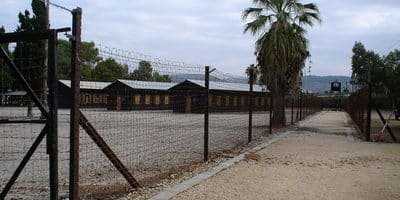
Boats, which were arranged by the Mossad and operated by the Haganah and volunteers from the Diaspora carrying refugees from the Holocaust and from Arab Countries, would arrive covertly late at night to unfrequented beaches in Israel. Many of the boats were intercepted by the British and the people were taken ashore and transported to Atlit, some managed to avoid British Patrol Boats and the immigrants actually made it to shore but were ambushed by the British on the beaches and rounded up and sent to Atlit. The Atlit Camp had barbed wire around it and armed guards.
One of the most heroic stories of those times is that of the bold and brilliant Palmach military operation led by Nahum Sarig Palmach and Yitzchak Rabin on the 10th October 1945 who successfully broke into the Atlit illegal immigrant detention camp and freed all 280 detainees who escaped and made their way on foot to Kibbutz Yagur, a distance of approximately 5 km from the camp.
After 1948 the camp was used as an absorption centre for the thousands of Holocaust survivors and refugees from surrounding Arab Countries.
Today the Atlit Detention centre is a national monument. In 1987 the Council for Israel Heritage Sites was allocated part of the 25 acres of the original camp to reconstruct and serve as a museum for visitors to learn about this very special time in Israel’s history. It enables visitors to have a firsthand experience of how traumatic it was for the immigrants detained there in conditions very much like those they had been subjected to in the extermination camps.
There is a ship at the site that is comparable in size and appearance to the ships that were used to transport the immigrants, a model of the barracks that housed the prisoners as well as a model of the reception area which was extremely traumatic as the detainees had to remove their clothes to be disinfected and had to shower, all bringing back memories of the concentration camps that they had recently been rescued from. Atlit also has a memorial to those who died while making their way by land and sea to the Land of Israel.


There are museums that are housed in two of the original buildings. One is Beit Aharonson which is devoted to the Nili underground resistance organization. This spy ring was pro British and operated during the First World War in what was then Turkish controlled Palestine. This organization was under the leadership of Aaron Aharonson and his sister Sarah Aharonson who was acclaimed around the world as an agronomist. The Aharonson family was part of the early settlement of the area. Another museum is that dedicated to the First wave of immigration to Israel (


Jerusalem is also holy to Christians as this is the place where Jesus’ ministry was marked by miracles as where he made a triumphal entry into the city and where the “Last Supper” (Passover Seder) took place on Mt Zion in 30 CE. This is also where Jesus’ arrest in the Garden of Gethsemane took place, followed by the trial, condemnation and the route of the
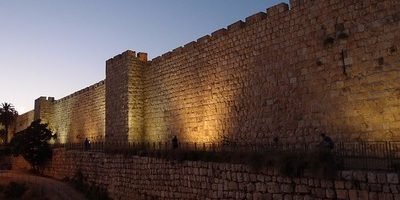
There is a mystical quality about Jerusalem that is unique and does not exist anywhere else in the world perhaps because of its exciting and splendid history and the hallowed atmosphere that surrounds all the holy sites. The captivating feeling in Jerusalem also probably emanates from the narrow alleys, vivid markets, magnificent stone walls and ancient buildings.
The Kibbutz has gone through a number of changes over the years but the original ideology of a society that is committed to social justice, mutual aid, the principle of joint property ownership, all receiving an equal education and all members having a home and all it implies according to their needs still remains in many kibbutzim.
It is 100 years since the first Kibbutz (named Degania) was set up near the shores of
A Kibbutz is not a village as no public roads runs through it and it is legally a completely private area. The economy is based on communal finances and economic and social activities are shared. There is a community kitchen with meals served in a communal dining room. Some Kibbutzim have tried sending food to members’ houses but the general consensus seems to be that members prefer communal dining facilities.
There have been many changes in the way the Kibbutz was run in the past and the way a number of kibbutzim are run today. Originally members joining a kibbutz were expected to transfer any assets that they had to the kibbutz. Now total equality has ceased and the concept of equality is provided mainly through food, health care and education. Children’s houses no longer exist and families live as a unit. Self management has been replaced with representatives elected by ballot. There are a number of other differences in various kibbutz movements but generally the kibbutz movement carries on. Many Kibbutzim also have hotel style guest houses for visitors and tourists to stay at while traveling around Israel.
During his teens he was a chess prodigy, performing in blindfold exhibitions against adults. Sharansky claims that during his imprisonment in the Soviet Union he played chess in his mind against himself. In 1996 in a chess exhibition in Israel he beat the world chess champion Garry Kasparov.
Sharansky applied for an exit visa to Israel in 1973, which was refused. After that he was at the forefront of Jewish refusenik actions until 1977 when he was arrested and in 1978 he was convicted on trumped up charges of spying on behalf of the United States and sentenced to 13 years in prison. After 16 months in Lefortovo prison most of the time in a special “torture cell” in solitary confinement he was transferred to a prison camp in Siberia.
For many years Israel has been distributing various technologies all over the world about how to conserve and efficiently use water with new systems of water recycling and reclaiming of water resources. In 1955 the first practical
In the field of production of seed and the development of special varieties of fruit and vegetables, Israel is a world leader. Strains of cherry tomatoes as well as melons and citrus fruit have become top market leaders in Europe and many other countries including South Africa, Iran and Morocco. 60%-70% of spices marketed in Europe come from Israel. Many other Israeli developments are being marketed and grown around the globe.