Jerusalem holds a number of sites that are important to Christians and hold great religious significance from both the Old and the New Testament.
Garden of Gethsemane
According to the Gospels, the Garden of Gethsemane situated on a slope on the Mount of Olives in the Holy Land was a place that Jesus and his disciples frequently visited to pray and is also the place where Jesus was betrayed and arrested on the night before his crucifixion.
Some of the world’s oldest olive trees dating back more than 2000 years are found in this spot today and possibly were young saplings on that night that followed the Last Supper when Jesus came to this olive grove with his disciples. This site is visited regularly by Christian pilgrims to the Holy Land.
Church of All Nations
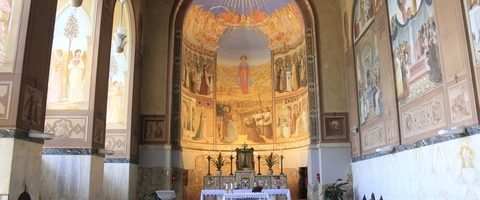
The Roman Catholic Church of All Nations is situated next to the Garden of Gethsemane on the slopes of the Mount of Olives (also known as the Basilica of the Agony). It was built between 1919 and 1924 on the site of a 4th century Byzantine Basilica that was destroyed by an earthquake and later a Crusader chapel that was abandoned.
It was designed by the architect Antonio Barluzzi. It is noted for the shimmering gold leaf mosaics that mark the frontage that depict Jesus carrying the suffering of the world.
Via Dolorosa
The mile long route of the Via Dolorosa that runs through the Old City of Jerusalem in the Holy Land, leads from the Antonia Fortress to Golgotha (Calvary) which was the place of the crucifixion. At each of the 14 Stations of the Cross that mark the Via Dolorosa there is a marker or chapel depicting the final journey that Jesus took. Christians of all denominations follow this route as part of their pilgrimage to the Holy Land. The Church of the Holy Sepulcher stands at the traditional site of Calvary.
Church of the Holy Sepulcher
The Church of the Holy Sepulcher stands at the traditional site of Calvary and for orthodox Christians it is the most significant pilgrimage destination and recognized as the Hill of Calvary (Golgotha), where Jesus was crucified and buried. Christian pilgrims have been visiting this site for centuries. The Sepulcher itself is contained within the rotunda and is surrounded by columns that support an adorned, domed roof. The Church itself was neglected for many years and renovations are still ongoing however the building has already regained much of its former beauty.
Hall of the Last Supper
The room of the Last Supper is located on Mount Zion in Jerusalem directly above the Tomb of David. It is also called the Coenaculum or Cenacle. According to Christian tradition it was here that Jesus sat with his disciples on the last Passover Night before his capture, trial and crucifixion.


More than 6000 years ago during biblical times Abu Gosh was called Kiryat Ye’arim and was a centre where the
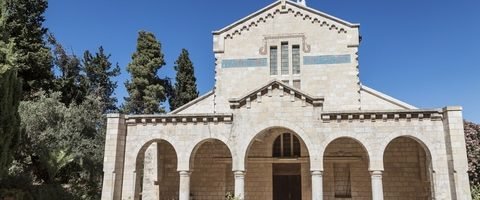
At the highest point of the village and facing the inspiring views of the Jerusalem Hills and surrounded by gardens is the lovely Church of our Lady of the Arc of Covenant (The Church of Notre Dame de l’Arche d’Alliance) was built on the ruins of an ancient Byzantine Church. In the Church Courtyard there is a large statue of Virgin Mary which is visible from all points of the compound. The convent itself belongs to the French order of St.Josef de l’apparition and the imposing church is home to the Abu-Gosh Liturgical Festival. During the 1948 War of Independence the convent was used as a military hospital.