The Galilee area is where Jesus grew up and began his teachings. Many of the miracles that He performed were in this region.
Yardenit
The revered Baptismal site of Yardenit (meaning “little Jordan” in Hebrew) is visited by many thousands of Christian pilgrims every year when touring the Holy Land. A large number of whom choose to have second baptisms or rededications at this charming location.
This significant site is located in a beautiful setting on the banks of the Jordan River, not far from where it flows out of the Sea of Galilee on its way to the Dead Sea, and is set amongst splendid eucalyptus trees and other natural river plant life which makes it an idyllic spot for recollection in peace and calm.
Church of the Annunciation
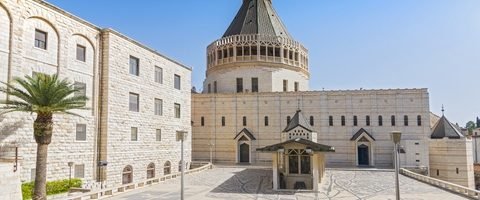
The Church of the Annunciation in Nazareth was consecrated in 1969 and was built over the Byzantine and Crusader foundations and is today the central point of Christian and Catholic pilgrimages to the holy land.
The remains of the previous churches are visible in the lower church which is centered on the Cave of the Annunciation which is believed to be the place where the angel Gabriel announced to the Virgin Mary that she would give birth to Jesus.
The beautiful very large upper Church is decorated with mosaics of the Virgin that worldwide communities have donated and is noted for its 55 meter concrete dome, shaped like a Madonna lily, which is a symbol of the Virgin Mary.
Tabgha
Tabgha originates from the Greek word Heptapegon meaning “seven springs” and
is located in a tranquil cove on the northwestern shore of the Sea of Galilee, at the foot of the Mount of Beatitudes and not far from Capernaum. According to the Gospels this is where the Miracle of the Multiplication of the Loaves and the Fishes took place that fed a multitude. It is also remembered for Jesus’ third appearance to his disciples after his resurrection.
Mount Tabor
This gently inclined mountain, approximately 1800 feet high, located in the Jezreel Valley to the west of the Sea of Galilee attracts numerous pilgrims visiting the holy land, due to its importance in both the Old and New Testaments alike.
Mount Tabor is also known as the Mount of the Transfiguration because of the belief that it is the place that Jesus was recognized as the Son of God.In 1919 the building of the “Church of the Transfiguration” an imposing Catholic church began on the peak of Mount Tabor. Aside from this Franciscan Church there is also a more modest Church dedicated to the prophet Elijah.
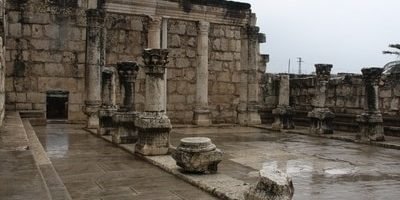
This ancient fishing village is located on the shore of the Sea of Galilee and is the place where Jesus first began to preach in the ancient synagogue and where he made his home during the years of his ministry after leaving Nazareth and is often referred to as Jesus’ “own city”. Many miracles occurred here and it is here that “walking in the footsteps of Jesus” takes on an awesome meaning.
Excavations have uncovered the original synagogue and the surrounding ruins are powerful reminders of Jesus’ life. An interesting feature is Peter’s house which was a minimal dwelling similar to others unearthed in the village and yet differs because of the many inscriptions and blessings written on the walls by pilgrims showing both Jesus’ and Peters names.
Today the ruins are owned by the Franciscans who manage the western part including the synagogue and the Greek Orthodox Church whose portion includes the white church with red domes.
Caesarea Philippi- Banias
The ancient site of Caesarea Philippi (Banias) is a place of extreme natural beauty as well as having an exciting history with an express connection to Jesus’ life as it is the place where he asked his disciples to tell him who people believed him to be.
It is located 25 miles north of the Sea of Galilee at the base of Mt. Hermon and it is here that one of the largest springs feeding the Jordan River is to be found and the plentiful water supply has resulted in lush vegetation and beautiful shady hiking trails as well as interesting archeological remnants from a variety of time periods.