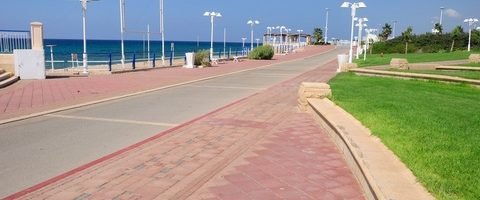
The Town of Atlit in Northern Israel is situated on the Mediterranean coast South of Haifa. It was originally a Crusader outpost. In 1903 the new village was founded with the help of Baron Edmond de Rothschild.
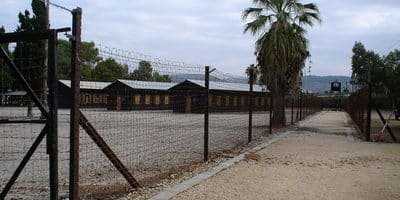
Atlit is best known for the place where the British built a military camp in 1938 and was used by them as a temporary holding Camp from 1939 until 1948. At first thousands of Jewish refugees fleeing Europe were detained in the camp and later it was used for holocaust survivors deemed to be illegal immigrants to Palestine. This was a direct result of the infamous “White Paper” that limited the number of Jews that would be allowed into the country.
Boats, which were arranged by the Mossad and operated by the Haganah and volunteers from the Diaspora carrying refugees from the Holocaust and from Arab Countries, would arrive covertly late at night to unfrequented beaches in Israel. Many of the boats were intercepted by the British and the people were taken ashore and transported to Atlit, some managed to avoid British Patrol Boats and the immigrants actually made it to shore but were ambushed by the British on the beaches and rounded up and sent to Atlit. The Atlit Camp had barbed wire around it and armed guards.
One of the most heroic stories of those times is that of the bold and brilliant Palmach military operation led by Nahum Sarig Palmach and Yitzchak Rabin on the 10th October 1945 who successfully broke into the Atlit illegal immigrant detention camp and freed all 280 detainees who escaped and made their way on foot to Kibbutz Yagur, a distance of approximately 5 km from the camp.
After 1948 the camp was used as an absorption centre for the thousands of Holocaust survivors and refugees from surrounding Arab Countries.
Today the Atlit Detention centre is a national monument. In 1987 the Council for Israel Heritage Sites was allocated part of the 25 acres of the original camp to reconstruct and serve as a museum for visitors to learn about this very special time in Israel’s history. It enables visitors to have a firsthand experience of how traumatic it was for the immigrants detained there in conditions very much like those they had been subjected to in the extermination camps.
There is a ship at the site that is comparable in size and appearance to the ships that were used to transport the immigrants, a model of the barracks that housed the prisoners as well as a model of the reception area which was extremely traumatic as the detainees had to remove their clothes to be disinfected and had to shower, all bringing back memories of the concentration camps that they had recently been rescued from. Atlit also has a memorial to those who died while making their way by land and sea to the Land of Israel.


He was an outstanding friend of the Jewish People and had an unwavering belief in the Zionist Cause. This brave and yet controversial man soon received the Hebrew nickname “Hayedid” (Friend).
Wingate devised the concept of small units made up of elite volunteers to go into action to put an end to terrorism in Northern Palestine. In this way the offensive would be carried to the enemy by taking the initiative and keeping him off balance. Actions like this had already begun by the Haganah under the leadership of Yitzchak Sadeh who later stated that they had less skill but the same ideas as Wingate, but that on his arrival they found a leader.
There is a memorial to Orde Wingate and the Chindits (British-Indian Special force) in London near the Ministry of Defense, on the north side of the Victorian Embankment. On this memorial there is a mention of his contribution to the State of Israel.


The Jewish Legion